Restaurant builds fall apart at the handoffs. A design gets approved, permits move forward, and then the build phase starts without a clear owner of the coordination layer. Trades conflict, inspections get missed, and the opening date slips. In NYC, that kind of friction is expensive.
Restaurant construction project management is the system that prevents it. A structured project manager owns the schedule, tracks the budget, sequences the trades, and keeps every stakeholder aligned from pre-construction through closeout. This article explains how that role works and what it delivers for NYC restaurant owners.
How Structured Project Management Works on an NYC Restaurant Build
- The project manager is the single coordination owner across every trade, vendor, and inspection during the active build.
- Architects handle DOB filing. Contractors may pull permits after filing is approved. Blueberry Builders coordinates but does not file DOB submissions.
- NYC scheduling requires active management of delivery windows, noise restrictions, and building access limits. These constraints must be built into the timeline from day one.
- Change orders are inevitable on restaurant builds. Structured documentation prevents cost surprises from compounding.
- Inspection readiness is planned, not reactive. Rough-in checks, kitchen-related approvals, and final sign-off each require advance coordination.
- Poor handoffs between design, pre-construction, and active construction are one of the most common causes of delay in NYC restaurant projects.
- A restaurant build in NYC typically requires a food service establishment permit in addition to DOB approvals. Coordination between these processes affects the overall timeline.
What a Restaurant Construction Project Manager Actually Does
A project manager on a restaurant build does more than administer paperwork. They keep the job moving when something goes wrong, and something always goes wrong.
The PM role sits above the day-to-day construction management function. Blueberry Builders’ project managers set the schedule and budget and own the owner relationship, while the firm’s on-site construction management team executes daily trade coordination. Understanding construction managers and general contractors helps clarify who owns what once the build is underway.
The PM as the single point of coordination
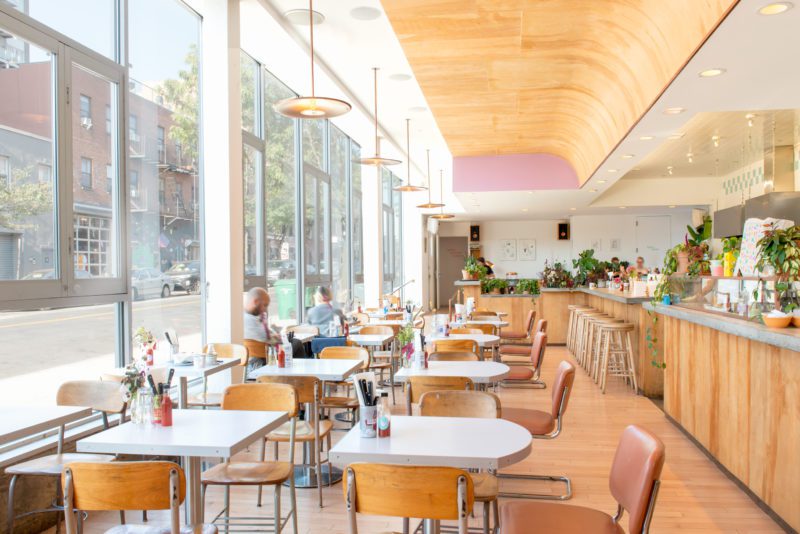
Every trade on a restaurant build operates on its own schedule. The PM owns the layer above all of them. They manage the communication flow between the owner, architect, subcontractors, vendors, and building management.
When a conflict arises between two trades, the PM resolves it before it causes downtime. When a decision needs to reach the owner, the PM frames it clearly and tracks the response. The PM keeps the project from fragmenting into a set of disconnected workstreams.
Day-to-day responsibilities during an active build
On an active restaurant build, the PM’s week includes daily site walks, trade check-ins, and material delivery tracking. They verify that work matches the approved drawings and flag deviations before they require rework.
Budget lines are reviewed against active scope. Inspection timelines are tracked against progress in the field. If a trade is running behind, the PM adjusts the sequence rather than waiting for the delay to compound.
Coordinating Stakeholders Across a Restaurant Build-Out
A restaurant project involves more decision-makers than most commercial interiors. The PM’s job is to keep all of them aligned around the same scope, schedule, and expectations.
Owner, architect, and contractor: who does what
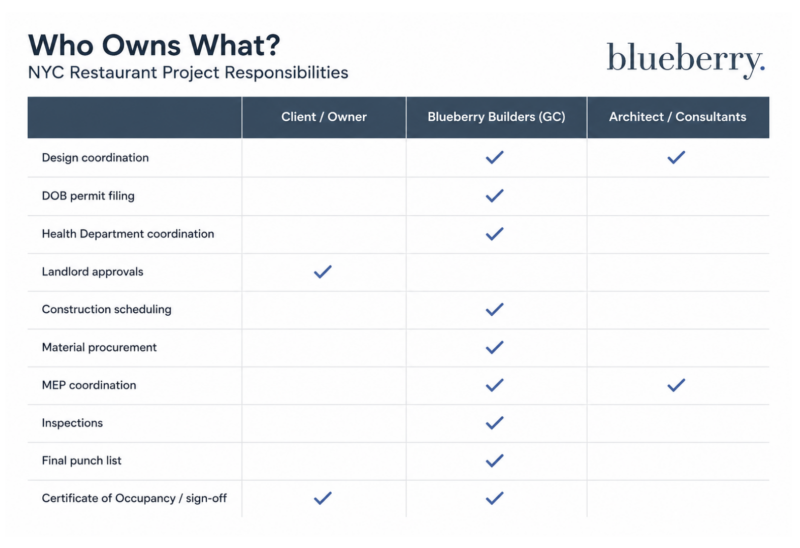
The architect is responsible for design drawings, DOB filings, and related documentation. Once filings are approved, the contractor may pull permits and begin work. Blueberry Builders manages construction execution and permit follow-through after approvals are in place.
Understanding filing vs. permitting in NYC is essential before the build begins. Blueberry Builders does not file DOB submissions but may advise on filing strategy and sequencing. Owners who expect the contractor to handle filing will encounter delays. Clarifying the role split early keeps the project moving without gaps in responsibility.
Managing subcontractors and trade sequencing
A restaurant build involves more trades than a standard commercial interior. Plumbing, electrical, mechanical, exhaust, fire suppression, and finish carpentry all share the same space and schedule.
The PM sequences these trades so each crew works without blocking the next. Framing must finish before mechanical rough-in. Rough-in must be inspected before walls close. Kitchen infrastructure must be confirmed before finish work begins around it.
Communication with ownership throughout the build
Owners should not have to chase updates. The PM provides structured check-ins tied to schedule milestones, not just when problems arise. When a change order is needed or a decision affects the timeline, the owner receives a clear summary and a recommended path forward.
That’s part of schedule control, not just a courtesy. Delayed owner decisions create gaps in the work sequence. Proactive communication keeps those decisions on time.
Explore our commercial interior construction services to see how Blueberry Builders structures the coordination layer on complex NYC builds.
Managing the Restaurant Construction Schedule
On a restaurant build in NYC, the project schedule changes constantly as conditions on site change.
Building the project timeline from pre-construction through closeout
A restaurant build schedule is built around trade phases, inspection windows, and procurement deadlines. Each of these depends on the one before it. Sequencing and scheduling for NYC commercial builds follows a structured logic that applies across project types, and restaurants add kitchen-specific milestones on top of the standard sequence.
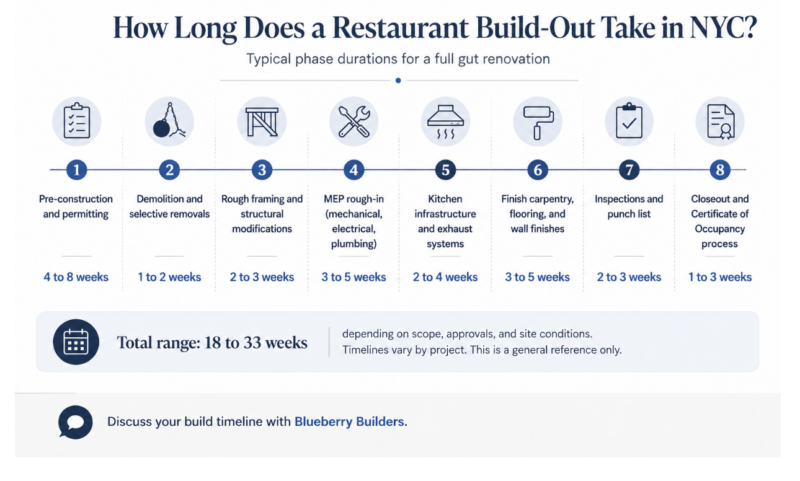
Key phases include demolition, framing, rough MEP, kitchen infrastructure, finish work, inspections, and final closeout. The PM uses the schedule to identify dependencies, plan procurement lead times, and protect inspection windows.
How delays happen and how they get handled
Material lead times, inspection rescheduling, and trade overruns are the most common sources of delay on NYC restaurant builds. None of them are inevitable if the PM is tracking the schedule actively. Construction site delays in NYC follow predictable patterns, and a structured PM addresses them before they affect the next trade in the sequence.
A PM who is actively monitoring the schedule catches these shifts before they compound. They resequence the trades around the delay, adjust procurement timing, and communicate the impact to the owner.
NYC-specific scheduling pressure
NYC adds scheduling constraints that most markets do not face. Delivery windows are often restricted by building management or local noise ordinances. Freight elevator access must be reserved in advance. Neighboring tenants have occupancy requirements that limit certain types of work to specific hours.
These constraints belong in the schedule from day one. A PM who builds around them avoids the stop-work situations that come from discovering them mid-project.
Keeping the Budget Aligned During Construction
Budget management during an active restaurant build means tracking actual spend against approved scope as the work progresses, a different discipline from pre-construction estimating. Effective value engineering in construction starts before the build, but the discipline of cost control continues through every active trade.
How project budgets are tracked against scope
Each trade’s invoiced work gets checked line by line against what the original contract scope actually included. When work exceeds what was included in the contract, it is flagged before the cost accumulates. Owners who receive regular budget updates make better decisions at decision points.
Change orders and scope shifts
Change orders happen on almost every restaurant build. Hidden conditions, owner-requested additions, and late design changes all generate additional scope. The risk is in change orders that are not documented or approved before the work proceeds.
A structured PM processes every change order with a written scope description, a cost impact, and owner sign-off before work begins. Working with a full-service general contractor with documented change-order protocols reduces the financial risk of scope shifts on a complex NYC build. This keeps the budget traceable and prevents disputes at closeout.
Talk to our team about structuring your build budget.
Permit and Inspection Coordination in NYC Restaurant Builds
A missed inspection or an out-of-sequence approval can halt a restaurant build for days, which makes this coordination layer one of the most consequential parts of managing a project in NYC.
Who handles permits versus filing in NYC
Architects handle DOB filings, which include submitting drawings, forms, and related documentation. Once those filings are approved, the contractor may pull the associated permits. Some permits may be pulled without a prior filing. Blueberry Builders does not file DOB submissions. The firm coordinates closely with the project architect and may advise on filing strategy, but the filing responsibility remains with the architect.
Owners should also plan for the NYC food service establishment permit process. It runs parallel to DOB approvals and has its own timeline and requirements.
Sequencing inspections without stalling the build
Inspections must be built into the schedule as hard milestones. Rough-in inspections for plumbing, mechanical, and electrical systems must clear before walls close. Kitchen hood and suppression installations require FDNY-related coordination before final finishes go in around them.
The PM tracks where the project stands against each inspection milestone and schedules the related work to hit those windows without gaps.
Handoffs That Keep the Build Moving
Most project delays happen at the transitions between phases, not in the middle of an active one.
Design to pre-construction
Before construction starts, several things must be confirmed. Subcontractor scope must be aligned with the drawings. Procurement of long-lead items must be underway. Permit status must be known so the schedule reflects the actual start date. Investing in structured pre-construction services before the build begins prevents the first week of construction from being a week of logistics problems.
Coordinating Finishes And Trade Handoffs
Finish trades run alongside active construction rather than after it, and the PM owns the handoff between them. Custom millwork, tile, lighting, and acoustic elements each depend on preceding trade work being complete and inspected. A sequencing gap at this stage creates rework and holdups in the final stretch of the build.
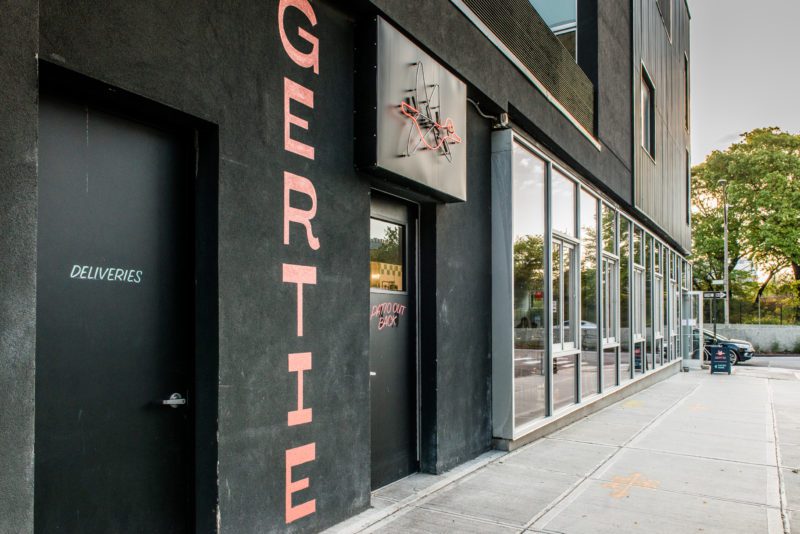
The Gertie project in Williamsburg illustrates what structured finish coordination produces. Blueberry Builders managed custom metal and millwork, full MEP systems, ANSUL and kitchen exhaust, and a complete storefront build-out. The project earned Eater’s 2019 Design of the Year. Finish selections affect more than aesthetics. Material choices influence trade sequencing, lead times, and inspection requirements. Owners who make restaurant remodeling decisions for NYC dining spaces before the build begins create fewer mid-construction pivots.
Construction phase to inspections and closeout
As the project approaches completion, the PM manages the punch list, coordinates final inspections, and tracks the steps required for Certificate of Occupancy or Temporary CO. Not every project requires a new CO. When the use group is unchanged, the existing CO may remain in place. The PM works with the architect to confirm requirements and schedule construction to support their inspection process.
Remodeling a restaurant in NYC without compounding cost and schedule risk requires the same structured PM approach as a full gut renovation.
Closeout documentation, including as-built drawings, equipment warranties, and maintenance records, is prepared and delivered as a package at project completion.
What Structured Project Management Delivers for Restaurant Owners
Owners who have experienced a poorly managed build understand what the absence of project management costs. It shows up in delays, unresolved trade conflicts, and cost overruns that were not flagged until it was too late to course-correct.
Structured restaurant construction project management delivers a different outcome. Cost drift and schedule slippage are caught earlier when the PM is actively tracking them. Owners receive updates before they have to ask for them. Trade conflicts are resolved at the schedule level, not after they cause downtime. The project moves toward opening with a known path and a documented status at every milestone.
For owners evaluating how to approach a restaurant build-out in NYC, Blueberry Builders offers pre-construction consultation to review scope, schedule, and coordination requirements before work begins.
Talk to our team about your restaurant build-out to discuss your project timeline and what structured management looks like from day one.